
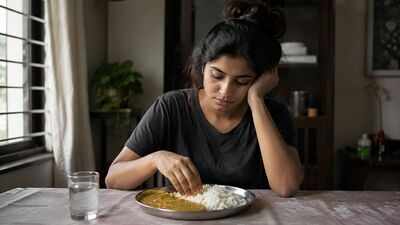
Psychology suggests that the way you eat dal chawal when you are alone may reveal more about your stress levels than most people realise. Research on stress and eating behaviour shows that chronic stress can override the brain’s natural satiety signals and increase cravings for high-calorie, highly palatable foods. In such states, even simple meals like dal chawal can become emotional comfort rather than just physical nourishment. Studies from neuroscience institutions, including research published in journals such as Neuron, titled, ‘Critical role of lateral habenula circuits in the control of stress-induced palatable food consumption’, indicate that stress-driven changes in reward circuits can push people towards repetitive and pleasure-seeking eating patterns. This makes everyday habits like how someone eats a bowl of dal chawal alone a subtle behavioural clue about emotional strain and coping style in behavioural science.
Dal chawal and the behavioural psychology of eating alone under mental pressure
Under stress, the brain does not keep hunger, comfort, and reward in separate compartments. They start to overlap in subtle ways that are difficult to notice from the outside. A simple bowl of dal chawal can shift from being just food into something closer to a pause, a brief soft landing in a mentally noisy day. Nothing about this shift feels dramatic. It does not announce itself. It appears in small behaviours. Finishing the meal faster without intending to. Taking a few extra spoonfuls even when fullness has already arrived. Or sitting in front of the plate longer than expected, not really eating at first, just moving things around.Work on stress and eating patterns suggests that prolonged pressure can alter how the brain reads satisfaction. The internal signal that normally says “enough” becomes less reliable. Food does not lose its basic purpose, but it gains a slightly different emotional weight.
Dal Chawal: Science behind the ‘comfort food’
Dal chawal is not designed as comfort food in any deliberate sense. It does not carry branding or intention. According to the research published in the Journal of Scientific and Engineering Research, titled, ‘Traditional Indian Foods’, dal chawal is the staple food of India, which exists in many Indian homes, that is neither special nor demanding. That familiarity is what makes it quietly important. When mental energy is low, the brain tends to avoid decisions. Dal chawal does not require any thinking beyond serving and eating. It is already known in taste, texture and outcome. There is no unpredictability in it.When eaten alone, that relationship becomes clearer. There is no conversation to stretch the meal or redirect attention. The rhythm is entirely internal. Some people eat quickly, almost automatically, as if finishing the food will clear mental space. Others slow down without noticing, caught in drifting thought, the spoon moving more out of habit than intention.
The unpredictable nature of appetite under stress
As reported by the study published in Pubmed, titled, ‘Stress, eating and the reward system’, suggests that stress does more than increase hunger. Chronic stress activates the body’s stress-response system, raising cortisol levels, which can influence appetite and food preferences. The authors argue that stress and eating are closely linked through the brain’s reward pathways, causing food to become a source of emotional comfort as well as nutrition. As a result, familiar or highly palatable foods may feel more rewarding and satisfying during periods of prolonged stress.Shared meals carry a kind of invisible structure. Even without planning, conversation interrupts eating, attention shifts, pauses appear naturally. Alone, that structure disappears. What remains is internal pacing, and that is where small inconsistencies begin to show. Stress can weaken the body’s usual cues about fullness. It does not always lead to eating more, but it can make the process less predictable. Stopping becomes less clear-cut than it should be.Sometimes it works the other way. Appetite drops without warning. Food is left unfinished, not because of dislike but because attention has moved elsewhere. The plate becomes secondary to thought. Stress does not behave in one direction. It distorts rather than defines.
Link between stress and eating behaviour
The researchers found a strong relationship between higher perceived stress levels and a greater tendency to eat in response to emotions rather than physical hunger, as reported by the study published in PubMed Central, titled, ‘Relationship between perceived stress and emotional eating. A cross sectional study’, suggesting that stress can influence eating behaviour in subtle ways. Instead of eating solely to satisfy hunger, people under pressure may turn to food for comfort, distraction, or emotional relief. The study highlights how periods of prolonged stress can increase the likelihood of emotional eating, reinforcing the idea that food often serves psychological as well as nutritional needs during difficult times.Another PubMed Central study, titled ‘Characteristics of Eating Alone Affecting the Stress, Depression, and Suicidal Ideation’, found that Chemical signals linked to reward and stress interact in ways that can make food slightly more noticeable than usual. Not in an intense way, more in the sense that it becomes harder to ignore.This is where simple meals like dal chawal become quietly useful for understanding behaviour. They are not driven by novelty or indulgence, so changes in how they are eaten tend to reflect internal state more than craving. The difference is not in the food itself but in pacing, attention, and stopping point. Over time, patterns can appear. Eating faster on certain days. Skipping finishing portions on others. Returning for seconds without much awareness of why. None of this is fixed or consistent, but repetition gives it shape.
Why do eating patterns reflect change more than cause
This review by Adam and Epel (2007) explores how chronic stress can influence eating behaviour and contribute to obesity. The authors argue that stress activates the body’s stress-response system, increasing cortisol levels, which can affect both appetite and food preferences. Rather than simply making people hungrier, stress may increase the rewarding value of calorie-dense foods by interacting with the brain’s reward pathways.The paper published in PubMed, titled ‘Stress, eating and the reward system’, proposes a model called Reward-Based Stress Eating, suggesting that stress and highly palatable foods activate similar reward systems in the brain. Over time, repeated activation of these pathways may encourage overeating and make comforting foods more appealing. The authors also discuss how stress can disrupt hormones involved in hunger and fullness regulation, including leptin and insulin, potentially leading to increased food intake and fat accumulation.Dal chawal, eaten alone, does not reveal anything on its own. But the way it is eaten can shift with mental load, fatigue, and emotional pressure. Speed changes. Attention changes. The sense of “enough” becomes less steady. In the end, it is not the meal that carries meaning. It is the small deviations around it. The pauses that should not be pauses. The rush that was not planned. The unfinished plate was not decided. Things that appear ordinary until they start repeating in patterns that are hard to ignore.